



get to know us
The Unseen Shield: Why Your Roof is the Most Critical Investment in South Wales
In the rolling landscapes of the Neath Valley and along the windswept coastline of Swansea Bay, our homes face a unique architectural challenge. The British weather is famously unpredictable, but in South Wales, it is particularly relentless. We experience a higher-than-average rainfall and salt-heavy Atlantic winds that can find the smallest weakness in a building’s exterior.
At South Wales Roofing & Carpentry, we believe that a roof is more than just tiles and timber; it is a complex, breathing system designed to protect your family and your greatest financial asset. However, because the roof is “out of sight, out of mind,” it is often the most neglected part of the home until the first damp patch appears on a bedroom ceiling.
In this article, we take a deep dive into the world of professional roofing, exploring the common pitfalls of modern maintenance and how a commitment to artisan standards can save homeowners thousands of pounds in the long run.

The Anatomy of a Failure: Why “Quick Fixes” Cost More
The roofing industry is unfortunately rife with “patch-up” culture. When a homeowner notices a leak, the instinct is often to find the cheapest, fastest solution. This usually involves a bucket of bitumen sealant or a few replacement tiles slid into place without addressing the underlying cause.
To understand why this fails, one must understand how a roof actually works. It is a layered defence system:
-
The Primary Layer: Your slates or tiles, designed to shed the bulk of the water.
-
The Secondary Layer: The roofing felt or breathable membrane, which acts as a safety net for wind-driven rain.
-
The Structural Layer: The timber rafters and battens that hold the entire weight of the system.
When you apply a “quick fix” to the primary layer, you are often trapping moisture between the layers. This accelerates rot in the timber and degrades the membrane, turning a £200 repair into a £10,000 structural failure within a few years. Our philosophy is different. We diagnose the root cause, whether it’s “nail sickness” in aging Welsh slate or the thermal movement of a poorly installed chimney flashing.
The Flat Roof Revolution: GRP and Beyond
Flat roofs have historically been the “problem child” of South Wales architecture. Older felt-and-bitumen roofs were simply not designed for the modern climate. They expand and contract at different rates than the timber beneath them, eventually leading to cracks, “alligatoring,” and the dreaded ponding.
We are leading a shift toward high-performance materials like GRP (Glass Reinforced Plastic) Fibreglass. Unlike felt, GRP is a seamless, cold-applied liquid that cures into a single, continuous skin. It is impact-resistant, fire-retardant, and virtually maintenance-free. But more importantly, we focus on the geometrical accuracy of the installation. We ensure the “fall” of the roof is perfectly calibrated so that water never has the chance to sit and stagnate.
Chimneys and Leadwork: The Artisan’s Touch
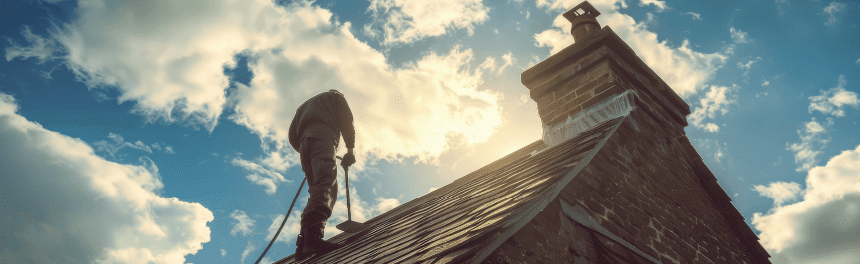
If you ask any experienced surveyor where a leak is most likely to start, they will point to the “junctions”—the places where the roof meets a wall or a chimney. These areas are sealed with lead flashing, a material that has been used for centuries because of its incredible durability and flexibility.
However, leadwork is an artisan craft that is becoming a lost art. Many general builders lack the specialist tools and knowledge to boss and dress lead correctly. At South Wales Roofing & Carpentry, we treat leadwork with the respect it deserves. We use the correct “codes” (thicknesses) of lead to ensure it can withstand the thermal expansion of a South Wales summer without cracking. When a chimney is correctly flashed and pointed with lime-based mortars, it doesn’t just look beautiful—it becomes a watertight fortress.
The Intersection of Roofing and Carpentry
What sets us apart is our dual expertise. Many roofing companies are just “tilers.” They understand how to lay a slate, but they don’t understand the timber skeleton beneath it. Because our roots are in master carpentry, we approach every roof with a structural eye.
If your roofline is sagging, we don’t just tile over it. We investigate the rafters. We look for “spreading” where the weight of the roof is pushing the walls out. We check the “feet” of the timbers for damp-induced rot. By combining roofing and carpentry, we can offer a “total envelope” service—ensuring the bones of your house are as strong as the skin is beautiful.
Get in touch today
Receive your free Online quote
We utilise online quotes strictly as an initial estimate or rough guideline for budgeting purposes. Please be advised that the definitive and confirmed project valuation for any roofing service can only be finalised following a comprehensive, on-site assessment. A qualified member of our dedicated assessment team will conduct a thorough inspection to accurately determine the full scope of work, necessary materials, and specific logistical requirements. This professional process guarantees that the final price you receive is accurate, comprehensive, and entirely transparent.
To proceed with scheduling your detailed, no-obligation site assessment and secure your confirmed quotation, please contact our office directly.

“Professional, Skilled, and Reliable”
Had a new roof installed by South Wales Roofing and Carpentry and couldn’t be happier with the results. Darius and his team were absolutely brilliant throughout the entire process. Professional, skilled, and reliable – exactly what you want when undertaking such an important home improvement project.
Tom -Google Reviews
continue reading